

Do You Have Tetrachromatic Vision? Take the Tetrachromacy Test
Most people see the world in millions of colors, thanks to three types of cone cells in the eye—red, green, and blue. But a rare group of people may see the world in a completely different way. Known as tetrachromats, these individuals have a fourth type of cone cell, allowing them to potentially perceive over 100 million distinct shades that others cannot even imagine.
This tetrachromacy test is designed to give you a fun and fascinating glimpse into whether you might have this extraordinary ability. While no online quiz can provide a medical diagnosis, it can highlight whether you experience unique sensitivity to subtle color variations—a common sign linked to tetrachromatic vision.
What Is Tetrachromacy?
-
Trichromacy (Normal Vision): Most people have three cones—red, green, and blue—that blend to form the color spectrum we see.
-
Tetrachromacy (Enhanced Vision): Some people inherit a fourth cone, giving them a richer, more nuanced perception of color.
-
Who Has It? Research published in National Center for Biotechnology Information (NCBI) suggests that up to 12% of women may carry the genetic potential, though only a smaller percentage actually experience tetrachromatic perception.
Signs and Symptoms of Tetrachromacy
While there is no single checklist, tetrachromacy symptoms often include:
-
Seeing more distinctions in colors that others describe as “the same.”
-
Easily spotting slight differences in paint swatches, fabrics, or digital screens.
-
Finding certain shades “vibrant” or “painfully intense” when others see little difference.
-
Struggling when others dismiss two colors as identical.
For a deeper dive, check out this overview from Healthline on what tetrachromacy is and how it’s studied.
What Causes Tetrachromacy?
Tetrachromacy arises from a genetic variation in the photopigments that detect color in the eye.
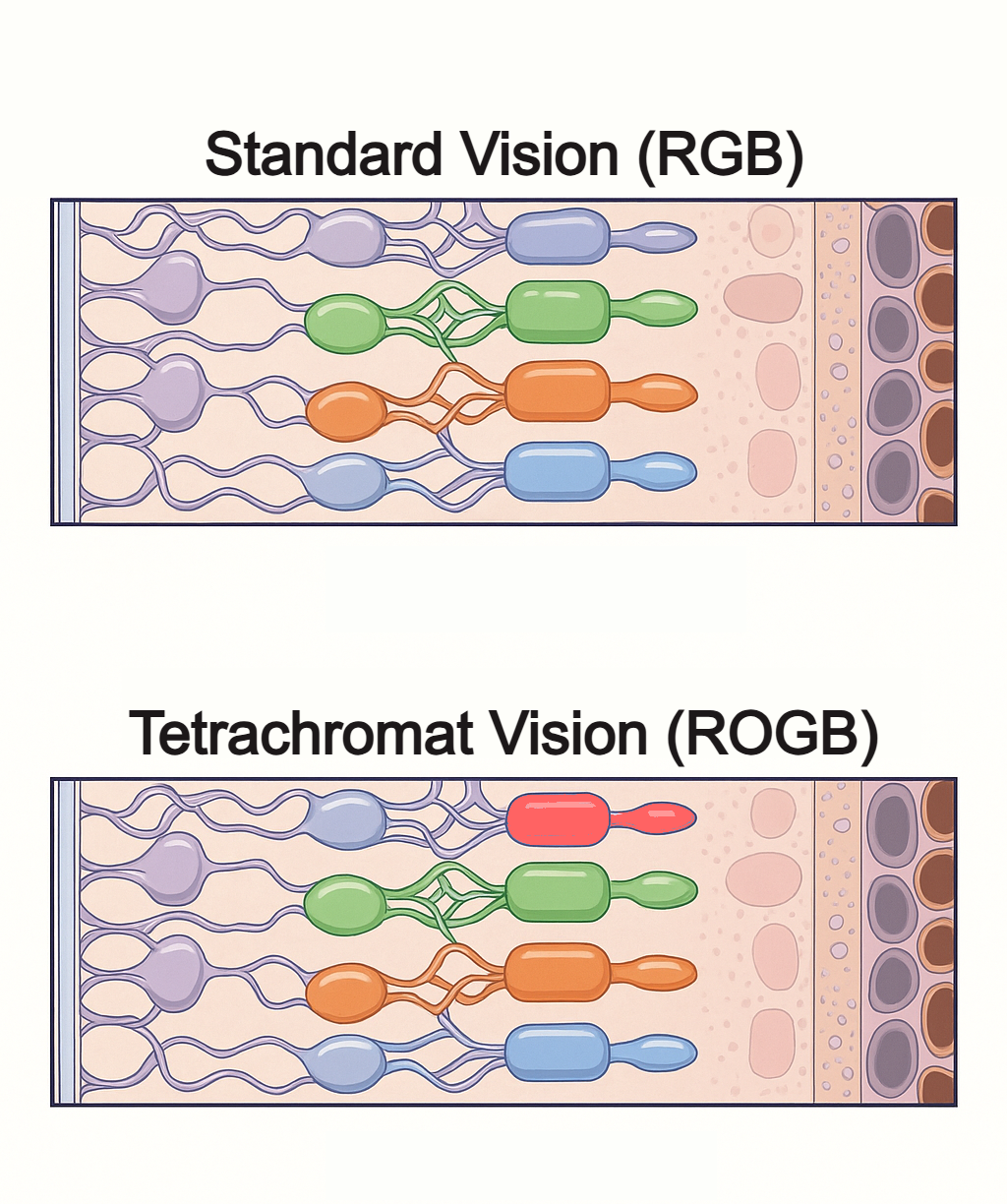
Most people have three types of cone cells:
-
Red-sensitive cones (L-cones)
-
Green-sensitive cones (M-cones)
-
Blue-sensitive cones (S-cones)
These cones combine signals to produce the full spectrum of visible colors.
In some individuals—most often women—a fourth type of cone develops. This typically happens because the gene for the red and green cones is carried on the X chromosome. Since women have two X chromosomes, they can inherit slightly different versions of this cone gene. When both versions are expressed, the result can be a fourth cone type, adding sensitivity to a new range of wavelengths.
Key points:
-
Genetic basis: Caused by variations in opsin genes on the X chromosome.
-
More common in women: Men (with only one X chromosome) are much less likely to carry the variation.
-
Linked to color blindness genes: In families with color blindness, women sometimes develop tetrachromacy because they inherit one “normal” and one “mutated” gene.
This additional cone doesn’t guarantee super-color vision, but in some people, the brain integrates the signals and creates an expanded perceptual palette of up to 100 million colors.
How the Tetrachromat Test Works
This quiz presents carefully selected images and color gradients. While most people will see only one or two distinctions, a potential tetrachromat may notice far more. Your answers will help reveal whether you fall closer to typical trichromatic vision or have traits associated with tetrachromatic vision.
If you’re curious about the science of color vision, the American Academy of Ophthalmology explains how cone cells shape the way humans perceive color.
Frequently Asked Questions About Tetrachromacy
1. How rare is tetrachromacy?
Estimates suggest that up to 12% of women may carry the genetic potential, but only a much smaller percentage actually experience enhanced color vision.
2. Can men be tetrachromats?
It’s very rare, but possible. Since men only have one X chromosome, they’re less likely to inherit the necessary cone variations.
3. What are common tetrachromacy symptoms?
-
Seeing subtle color differences others call “the same.”
-
Feeling overwhelmed by certain bright or complex color patterns.
-
Being highly sensitive in tasks like paint matching, fashion coordination, or digital design.
4. How do I know if I’m a true tetrachromat?
The only way to confirm is through specialized lab testing that measures cone responses. Online tests and quizzes are fun and informative but not diagnostic.
5. Can I train myself to become a tetrachromat?
No, tetrachromacy depends on genetics. However, you can train your visual sensitivity and learn to notice finer color differences with practice.
6. Is tetrachromacy related to eye health problems?
No — having an extra cone type does not negatively affect vision. It simply changes how the brain processes color signals.
Ready to See the World Differently?
Start the tetrachromacy test now and discover whether you may belong to the rare group of people who can see a world of hidden colors. Even if you’re not a true tetrachromat, this quiz will sharpen your awareness of just how fascinating human vision really is.
Explore More Quizzes
If you enjoyed the Tetrachromacy Test, you may also like:
-
🔗 Are You Colorblind? — Find out if you struggle to distinguish certain shades and learn which type of color blindness you might have.
-
🔗 Check Your Color Sensitivity — See how finely tuned your vision is by spotting subtle shade differences across gradients.
History lesson
Meet the color queeen
Concetta Antico, also known as "The Color Queen," is an Australian-American fine artist, art instructor, and a Tetrachromat. Born and raised in Australia, her passion for art has been a part of her life since her earliest memories. As a Tetrachromat, a genetic condition that gives her a fourth receptor in her eyes, Concetta perceives 100 million more colors than the average person. This unique ability has been scientifically endorsed by researchers at UC Irvine, California.
Concetta's artwork is renowned for its vibrant color usage and impressionistic scenes, a direct result of her unique visual processing of the world. Her goal is to portray reality in a way that is unlike anything viewers have experienced before. Her prolific body of work has been exhibited across the United States and Australia and is part of several private and public collections, including the Women’s Museum of California, The Dr. Wendy Martin Museum Collection, Rady Children’s Hospital, and collections of notable individuals like Robert and Allison Price, Brian Strauss, and Kevin Harrington.
Her work and her unique ability have caught the attention of major media outlets, with features in The Cut, Vogue, The Guardian, BBC, and The Wall Street Journal. Currently, Concetta divides her time between Sydney, Australia, and San Diego, California, where she continues to create and inspire with her art. Her life and work serve as a testament to the extraordinary potential of human perception and the transformative power of art.

Quiz Writer
Zach has been riding the gondola of trivia wherever the waters take him. Although he’s not a named consultant on any major quiz TV shows, Zach has watched them all since infancy and will happily take up any challenge whether it be pub quizzes or high-stakes matches he isn’t afraid to show up. And showing up is 90% of the work!
Did you know?
Only women have Tetrachromacy
In the back of the human eye, color receptors are shaped like cones. While most people only have three cones that recognize colors, those with tetrachromacy have four of these cones. The average human can see a fair number of colors, but for those lucky few with superhuman vision, it's easy to see over 10 million. Affecting up to 25% of women, it's unknown why the extra cone doesn't develop in males. On the other hand, those who experience color blindness tend to be male.
Interestingly enough, tetrachromats are naturally adverse to certain colors because they are too intense. Research shows that yellow is their least favorite color — they find it loud and abrasive. Technically called antico, the fourth cone receptor heightens the perception of color and often alters how tetrachromats prefer to decorate. While they love color, they also know when too much is too much.
How to Play?
Our personality quizzes are set up a little differently than your basic trivia quiz, but you’ve probably seen their kind around. Rather than having to choose the right answer from a list of multiple choice options, in this case, there is no “right answer”! (Two plus two will always be four, but every Golden Girls character is equally awesome.)
So, stop stressing. Just click on the answer that suits you best, and enjoy the ride. These quizzes are just for fun but who knows – you might just learn something about yourself along the way!
About Heywise
Get knOwledgeable! Heywise is where entertainment and trivia meet, like a turducken of fun. Anytime. Anywhere. Since 2017, Heywise has been a leader of quizzes on the web, on mobile devices, and across social media.
We explore a broad range of topics – from sports to history, language to pop culture, personality to health. Our quizzes motivate readers to test their knowledge and learn new and exciting facts.
We’re inspired by food and unique destinations around the globe. We love movies and TV shows, but most of all we love having the opportunity to share these passions with you.
Have you ever wondered what color represents your personality? Do you know which Hogwarts House you belong to? Are you a Pessimist or an Optimist? Our unique personality quizzes will help you find out! We want to share the knowledge of all things awesome with you.
We’re the best quiz site on the internet. That might be our opinion, but it’s pure fact that we get up in the morning expressly to share awesome, eye-opening knowledge with you. So, come get your brain pumping.